THE GIVING USA REPORT FOR 2023 SHOWS WHY NON-PROFITS NEED MULTIPLY REVENUE DELIVERY PLATFORMS TO SUSTAIN GROWTH.
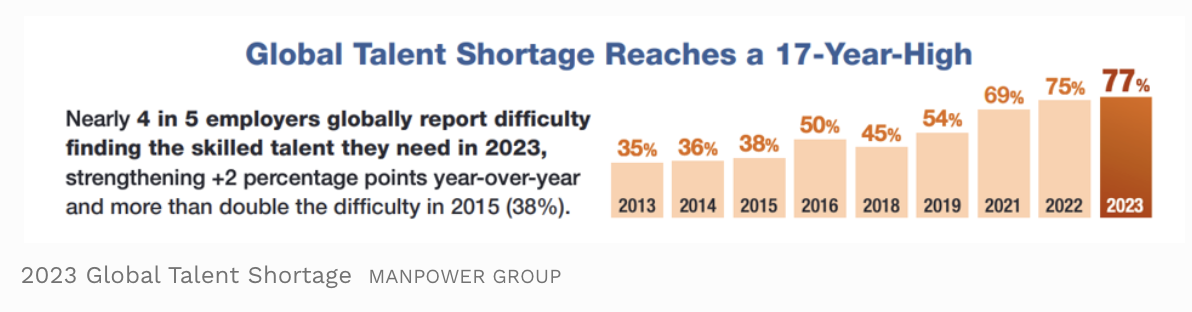
And 77% of employers are struggling to find the skilled leaders they need, a 17-year high, according to Manpower Group’s 2023 study.
THE NUMBER OF AMERICANS GIVING TO NON-PROFITS CONTINUES TO DECLINE.
The Giving USA report for 2023 just came out this week, and it shows a 2.1% drop in giving after inflation adjustment. More unfortunate news for our industry.
Worse still, the number of Americans who give declined once again (-2.4%).
This continues a troubling trend in the nonprofit industry. Just look at this difference over the last decade:
- In 2013, individual donors accounted for 73% of overall giving.
- In 2023, individual donors accounted for 67% of overall giving.
How did we get here? Giving Tuesday has dedicated itself to better understanding generosity by studying a wealth of data and following emerging trends. They’ve been publishing their findings in a quarterly report called GivingPulse.
The GivingPulse Q1 2024 Report may be a sign of hope. The report found that “all forms of generosity held steady in Q1, including the percent of people giving monetary donations.”


OUTSIDE LEADERSHIP MODELS AND OUTCOME-BASED PRODUCTION MADE TALENT COST-EFFICIENT
This is no surprise as 77% of employers are struggling to find the skilled talent they need, a 17-year high, according to Manpower Group’s 2023 study.
Adaptability is directly correlated to having the right talent and working on the right problems. Yet unfortunately for many non-profit organizations, finding the right talent at the right time is becoming more out of reach according to JP Morgan’s 2023 Midyear Business Leaders Outlook.
The reason the fractional economy is booming is that the outsourced leadership model and outcome-based production make talent cost-efficient. Moving an Executive Director, VP of Marketing, or Director of Donor Development with an average salary and benefits package of $150,000 a year to a senior fractional leadership model instead can be a game-changer for many non-profit organizations. Future savings in search firm fees, unemployment benefits, and 401K match fees are also possible by hiring 6 to 12-month fractional leadership teams when needed as opposed to short-term senior employees who might only last 14 months on average.
Grey hair is a mark of distinction, the award for a Godly life.
SENIOR FRACTIONAL LEADERS HAVE BETTER CUTTING-EDGE SKILLS THAN TRADITIONAL EMPLOYEES
Most non-profit boards find that senior fractional leaders seem to always have the latest and greatest skills available. Fractional leaders are increasingly specializing in catering to niche donor revenue delivery skills, faith-based causes, and regions of the country. As a result, CEOs are finding the fractional leadership model can be the biggest cost reduction opportunity as they launch new revenue delivery initiatives.
At Group 1631 we focus exclusively on creative revenue delivery platforms for our non-profit clients. Our portfolio hosts impressive case studies in faith-based education, cancer care, rescue missions, men’s ministry, pro-life, and healthcare.
More and more CEOs are moving in this direction because fractional senior leaders almost always have the latest and greatest skills available. We believe the rise of specialized fractional senior leaders will only increase. As AI and other new technologies create the need for new skills, grey matter senior leaders are better equipped to create winning strategies and oversee detailed execution deliverables than full-time employees. According to Deloitte’s Perspective, “The alternative workforce tends to update their skills more frequently and can typically ramp up within days rather than weeks”. Deloitte research found that 60% of seasoned fractional leaders have updated their skills in the past 6 months, compared to a much lower % of traditional employees who have updated their skills in the past 12 months..


NON-PROFIT LEADERS NEED A BLENDED STRATEGY TO FIND THE RIGHT TALENT
A recent Forbes article titled “How Freelancing is Becoming the New Leadership Path” discussed the importance of thinking of a blended strategy to finding talent: “The implication of workers becoming more fluid is that companies need to rethink employee experience and talent management. Rather than thinking about talent in terms of internal or external, and using success metrics like average tenure, companies need to prioritize the individual and plan for the individual to seek fluidity. The way companies can do this is by understanding that it shouldn’t matter whether an individual is an internal employee or an external freelancer. They’re still building relationships, delivering work, and learning the company culture no differently than full-time employees.”
This was also reinforced in a Harvard Business Review article that noted “Companies are embracing the freelance model more than ever before. Increasingly, the new workforce will consist of an inner circle of employees and outer circles composed of a range of independent workers.” It went on to say, “Today at least 36% of the U.S. workforce has chosen to work as contract, freelance, temporary, or gig workers, according to an extensive study conducted by McKinsey in 2022. Upwork’s December 2023 study of 3,000 professionals put the number at 38%, or 64 million workers.”
To learn more about why more faith-based non-profit boards and CEOs are hiring our Group 1631 fractionalized leadership team to make talent cost-efficient while delivering outcome-based strategies contact us at info@group1631.com.
Grey Matter Thinking
“Courage is the only virtue you cannot fake.” –Nassim Taleb


© 2004-2026 Group 1631. All Rights Reserved | Website Built & Maintained by Mars Hill Media